How to Select Reliable Clutch Component Manufacturers?

Time:2026-10-26 Author:Isabella
0%

Choosing the right supplier can determine whether a clutch performs smoothly or fails under heat, load, and repeated engagement. This guide explains How to select reliable clutch component manufacturers through practical, evidence-based checks.

In real purchasing work, a polished website proves very little. A dependable manufacturer should show material certificates, dimensional inspection records, fatigue-test results, and clear batch traceability. Ask how the supplier controls friction plates, pressure plates, release bearings, and torsion springs. Their answers should include measurable tolerances, testing equipment, and corrective-action procedures.

Quality expert W. Edwards Deming stated, “Quality comes not from inspection, but from the improvement of the production process.” That principle matters here. A factory should not merely reject defective parts at the final inspection. It should prevent defects through controlled machining, heat treatment, assembly checks, and documented process changes.

Look for experience with your vehicle type, operating temperature, torque range, and production volume. Request samples before signing a long-term agreement. Compare their measured results with your own inspection data. Small differences can become costly vibration, noise, or premature wear.

Communication also deserves attention. Reliable manufacturers explain limitations instead of promising everything. That is a good sign.

Still, no supplier-selection method is perfect. Audits can miss problems, and sample quality may not represent every batch. Regular reviews remain necessary. This article will help buyers assess technical capability, quality systems, delivery performance, and after-sales support before making a confident decision.
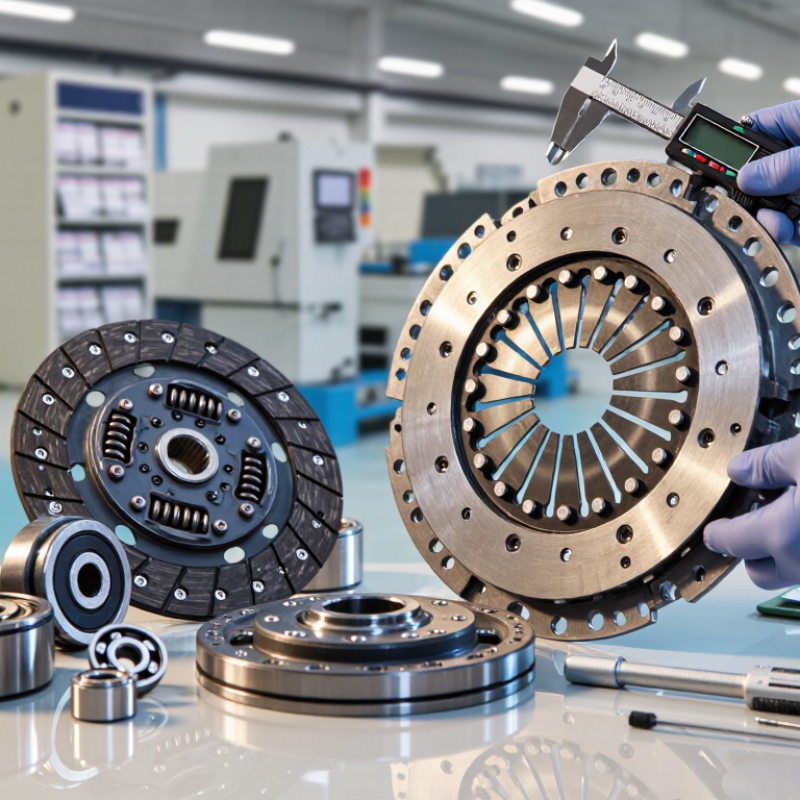
How to Select Reliable Clutch Component Manufacturers?

Define Your Clutch Component Requirements and Quality Standards

How to Select Reliable Clutch Component Manufacturers?

Before contacting a clutch component manufacturer, define the operating conditions clearly. Record torque, rotational speed, engagement frequency, temperature range, and available installation space. Specify the component type, such as friction discs, pressure plates, or release bearings. Include drawings with dimensions, tolerances, surface finishes, and mounting details. Small omissions can create expensive revisions later.

Set measurable quality standards, not vague requirements like “high performance.” Identify acceptable friction variation, wear limits, noise levels, runout, and service life. Ask for material certificates, inspection records, and documented test methods. A reliable supplier should explain how each result is measured. Request sample reports before approving production. Compare the report format with your own inspection process.

Our early checklist was too general. It focused on delivery dates but ignored thermal cycling and contamination exposure. That was a preventable mistake. Consider validation under realistic conditions, including repeated engagement, sudden load changes, and long storage periods. Define sampling levels, nonconformance procedures, and lot traceability in writing. Keep technical communication with qualified engineers, not only sales staff. Document every revision. Measure twice. Test once.

Research Manufacturer Expertise, Facilities, and Production Capabilities

Reliable clutch component manufacturers should demonstrate more than attractive catalogs. Their expertise must match your application, operating load, friction material, and expected service life. Ask how long they have produced clutch plates, hubs, covers, or release components. Request engineering records, process qualifications, and examples of similar projects. A confident supplier explains failure modes clearly, rather than promising that nothing will go wrong.

Visit the production facility when possible. Check whether machining, heat treatment, stamping, balancing, and surface finishing are controlled internally. Observe clean work areas, calibrated measuring tools, and visible inspection procedures. Small details matter. A worn fixture may affect runout. Poor storage can damage friction surfaces before assembly. Review equipment maintenance records and laboratory capabilities. The manufacturer should test torque capacity, wear, temperature resistance, dimensional accuracy, and fatigue performance under documented conditions.

Production capacity also deserves close examination. A factory may produce excellent prototypes but struggle with stable volume. Compare pilot-run results with later batch records. Ask how operators trace materials, control process changes, and handle rejected parts. Confirm whether backup equipment exists for critical operations. Do not rely only on claimed monthly output. It can be optimistic. A sample audit, dimensional report, and controlled trial order often reveal more than a polished presentation. I would also ask for honest limitations, because a supplier that admits one weak process may be more dependable than one that avoids every difficult question.

How to Select Reliable Clutch Component Manufacturers? - Research Manufacturer Expertise, Facilities, and Production Capabilities
Evaluation Area What to Examine Potential Warning Sign
Industry Expertise Relevant clutch-component experience Documented experience with friction discs, clutch covers, release bearings, flywheels, hydraulic components, or related power-transmission parts. Preferred At least three years of directly relevant production experience, supported by process records and technically comparable product examples. Risk General machining experience is presented without evidence of clutch or friction-material capability.
Quality Management Automotive quality-system control Current third-party certificate, certificate scope, issuing body, audit status, and documented corrective-action process. Required ISO 9001 certification is a baseline quality-system indicator. IATF 16949 certification is a stronger indicator for automotive production and supply-chain controls. Risk Expired certificates, an unclear scope, or certificates that do not cover the proposed manufacturing site.
Engineering Capability Design and application support Engineering team structure, drawing-review procedure, tolerance analysis, material selection records, and design-change control. Preferred Ability to review 2D drawings and 3D models, identify manufacturability issues, and document approved changes before production. Risk Sales personnel provide technical approval without documented engineering review or revision control.
Production Facilities Process equipment and capacity Equipment list, production-line photographs or audit access, rated capacity, maintenance records, and capacity by process step. Required Capacity should be demonstrated for forming, machining, heat treatment, balancing, friction-material processing, assembly, and final inspection as applicable to the component. Risk Capacity is stated only as a monthly total without identifying bottleneck operations or available reserve capacity.
Process Control Control of critical characteristics Process flow diagram, control plan, work instructions, inspection frequency, reaction plans, and traceability records. Required Critical dimensions, runout, flatness, hardness, friction-material properties, torque-related features, and balancing requirements should have defined controls where applicable. Risk Inspection is limited to final visual checks, with no documented controls for special or safety-related characteristics.
Measurement Systems Inspection accuracy and gauge control Calibration certificates, equipment resolution, measurement-system-analysis studies, gauge identification, and out-of-calibration reaction procedures. Required Measuring equipment should be traceable to recognized national or international measurement standards. Gage R&R studies are commonly used for variable measurement systems. Risk Calibration labels are present, but calibration traceability and measurement-system performance cannot be demonstrated.
Material Control Incoming material verification Approved-supplier list, material certificates, incoming inspection records, batch identification, and nonconforming-material controls. Required Steel, castings, friction compounds, elastomers, lubricants, and other critical materials should be linked to batch records and approved specifications. Risk Materials are accepted solely on supplier declarations without batch traceability or verification testing.
Testing Capability Performance and durability validation Test-plan templates, laboratory equipment list, test-method references, sample reports, environmental controls, and external-laboratory arrangements. Preferred Capability to conduct dimensional, hardness, torque, wear, thermal, fatigue, vibration, or friction-performance tests relevant to the supplied component. Risk The manufacturer provides certificates of conformity but cannot show test methods, raw data, or retained samples.
Launch Readiness APQP and PPAP discipline Process flow, FMEA, control plan, capability studies, dimensional results, material results, sample approval records, and change-notification procedures. Preferred A documented APQP process and PPAP-style submission capability are strong indicators of readiness for automotive customer requirements. Risk Production begins before drawings, samples, process controls, and acceptance criteria are formally approved.
Statistical Control Process capability and stability Control charts, capability reports, sampling plans, corrective-action records, and definitions for critical process parameters. Preferred Stable processes should be demonstrated with appropriate control charts. A Cpk target of 1.33 is a common customer requirement, but the applicable target must be agreed for each characteristic. Risk Capability indices are reported without sample size, normality review, process stability evidence, or specification limits.
Traceability Lot and production-record traceability Part marking method, raw-material lot, machine or line identification, operator records, inspection results, and shipment linkage. Required Each shipment should be traceable to a defined production lot and its associated material, process, inspection, and release records. Risk The supplier cannot isolate affected lots during a quality incident or recall investigation.
Subcontractor Control Outsourced special processes Approved-subcontractor list, process certificates, audit records, specifications, incoming verification, and change-control agreements. Required Heat treatment, coating, plating, balancing, friction-material processing, and other special processes should be controlled and documented even when outsourced. Risk Critical operations are subcontracted without clear ownership, qualification evidence, or incoming verification.
Delivery Reliability Capacity planning and on-time delivery Capacity plan, lead-time assumptions, safety-stock policy, production schedule, on-time-delivery history, and escalation contacts. Preferred The supplier should show how forecast changes, tooling constraints, maintenance downtime, and raw-material shortages are managed. Risk Lead times are quoted without capacity evidence, contingency planning, or a documented escalation process.
Environmental and Safety Environmental, health, and safety management Environmental permits, hazardous-material controls, worker-safety procedures, incident records, and relevant management-system certificates. Preferred ISO 14001 supports environmental-management evaluation, while ISO 45001 addresses occupational-health-and-safety management. Risk Friction dust, oils, solvents, noise, heat-treatment emissions, or waste streams are not addressed in documented controls.
Commercial Reliability Quotation transparency and total cost Itemized quotation, tooling charges, testing charges, packaging requirements, payment terms, warranty terms, and price-adjustment conditions. Preferred Compare total landed cost, tooling ownership, minimum order quantity, warranty exposure, inspection cost, and expected service life—not unit price alone. Risk An unusually low price is accompanied by vague material specifications, undefined warranty coverage, or hidden tooling costs.
Audit and Approval Pre-production supplier audit Completed audit checklist, corrective-action plan, closure evidence, sample approval, and documented management review. Required Final approval should follow document review, facility assessment, sample inspection, capability evaluation, and closure of significant audit findings. Risk Supplier selection is based only on a brochure, online listing, or a single sample without an on-site or remote technical audit.
Use the table as a supplier-screening framework. Applicable requirements should be confirmed against the part drawing, customer specification, vehicle application, legal requirements, and agreed quality plan.

Verify Materials, Testing Procedures, Certifications, and Traceability

How to Select Reliable Clutch Component Manufacturers?

A reliable clutch component manufacturer should explain its material choices clearly. Ask for grade certificates, heat-treatment records, and surface-hardness results. Steel quality affects friction stability, fatigue life, and dimensional consistency. Request samples before approving regular production. A polished sample can still hide weak internal control. That detail deserves attention.

Testing procedures reveal more than attractive product photographs. Confirm whether components undergo torque, wear, temperature, vibration, and endurance testing. Ask for test conditions, equipment calibration dates, and complete reports. Independent laboratory results add useful credibility. Certifications also matter, but certificates alone cannot prove daily quality. Verify their scope, issuing body, and validity.

Traceability should connect each part to a batch, operator, material source, and inspection record. When a defect appears, the manufacturer should identify affected units quickly. In practice, records are sometimes incomplete. That is a warning, not a minor inconvenience.

Tips:

Visit the facility if possible. Check whether storage areas are clean and labeled. Compare inspection records with actual production markings. Ask how nonconforming parts are isolated and corrected. Request a small trial order before making larger commitments. Keep written approval criteria. Revisit them after real-world use, because field conditions can expose weaknesses laboratory testing misses.

Compare Pricing, Lead Times, Communication, and Customization Support

Selecting a reliable clutch component manufacturer requires more than comparing the lowest quotation. In field evaluations, I examine material certificates, dimensional reports, and samples from actual production batches. A transparent supplier explains whether pricing includes tooling, inspection, packaging, and freight preparation. Hidden charges can distort an attractive offer. Ask for a cost breakdown tied to quantities and tolerance requirements. This reveals practical expertise, not polished sales language.

A realistic lead time should separate prototype approval, raw-material purchasing, machining, testing, and shipment. Request milestone dates rather than one broad promise. Reliable teams report delays early and propose workable alternatives. Communication matters daily. Can engineers answer technical questions directly? Do they confirm drawings, revision numbers, and surface treatments in writing? I once accepted an optimistic schedule without checking material availability. The first shipment slipped by three weeks. That mistake changed my evaluation process.

Customization support should include design review, tolerance feedback, and controlled sample approval. A capable manufacturer may question an unnecessary tolerance or suggest a more stable alloy. This can reduce cost without weakening performance. Ask how design changes are recorded and how inspection data is shared. Be careful with vague claims about “full customization.” Some suppliers outsource critical operations, complicating accountability. A trial order, clear acceptance criteria, and documented communication channel provide stronger evidence than promises.

Evaluate Samples, Customer Feedback, Warranties, and Long-Term Reliability

How to Select Reliable Clutch Component Manufacturers?

A dependable clutch component manufacturer should provide more than polished catalog photos. Request samples that match your intended load, temperature range, and installation space. Inspect spline edges, friction surfaces, spring tension, and machining marks under strong light. Measure critical dimensions with calibrated tools. Small deviations can cause vibration, premature wear, or difficult assembly. During evaluation, record noise, engagement feel, and heat after repeated cycles. One sample can impress you. It cannot prove consistency.

Tips: Ask for at least three production samples. Compare them side by side. Keep test records, including dates and measurements. If possible, use an independent laboratory for wear and material checks.

Customer feedback often reveals problems hidden during short trials. Look for comments about delivery accuracy, replacement support, batch consistency, and failures after extended use. Speak with customers who operate similar equipment. Their experience is more useful than general online ratings. A manufacturer should explain warranty coverage clearly, including exclusions, claim deadlines, and inspection procedures. Vague promises deserve careful questioning. Long-term reliability depends on traceable materials, controlled production, and responsive technical support. However, even strong suppliers can make mistakes. Ask how they investigate defects and prevent recurrence, not merely how they apologize. Reliability is demonstrated over months, not during one successful meeting.

FAQS

What information should I provide before contacting a clutch component manufacturer?

Provide torque, rotational speed, engagement frequency, temperature range, and installation space. Specify discs, pressure plates, or release bearings.

Which technical documents should accompany an inquiry?

Include drawings with dimensions, tolerances, surface finishes, and mounting details. Missing details can cause costly revisions.

How can I define measurable quality standards?

Set limits for friction variation, wear, noise, runout, and service life. Avoid vague terms like “high performance.”

What quality records should a reliable manufacturer provide?

Request material certificates, inspection records, test methods, and sample reports. Each result should have a clear measurement process.

Which operating conditions should product validation cover?

Test repeated engagement, sudden load changes, thermal cycling, contamination exposure, and long storage periods. Real conditions matter.

How should I evaluate a manufacturer’s quoted price?

Ask whether tooling, inspection, packaging, and freight preparation are included. Request a cost breakdown linked to quantity and tolerances.

How can I judge whether a proposed lead time is realistic?

Request milestone dates for prototypes, material purchasing, machining, testing, and shipment. One broad promise is not enough.

What communication practices indicate strong technical support?

Engineers should answer technical questions directly. Confirm drawings, revision numbers, surface treatments, and changes in writing.

How can I assess customization capability?

Look for design review, tolerance feedback, controlled samples, and shared inspection data. A capable supplier may challenge unnecessary tolerances.

What purchasing approach reduces avoidable risk?

Start with a trial order and clear acceptance criteria. Define sampling, nonconformance handling, lot traceability, and revision control. I once trusted an optimistic schedule. The shipment arrived three weeks late.

Conclusion

Learning how to select reliable clutch component manufacturers begins with clearly defining your application requirements, performance expectations, dimensions, operating conditions, and quality standards. A dependable manufacturer should demonstrate relevant industry expertise, suitable production facilities, skilled engineering resources, and the capacity to maintain consistent output. Review the materials used, inspection methods, testing procedures, certifications, and traceability systems to confirm that every component can meet your technical and quality requirements.

When comparing potential suppliers, consider more than the initial price. Evaluate lead times, communication, engineering assistance, customization capabilities, and their ability to respond to changing production needs. Request samples whenever possible and assess their fit, finish, durability, and performance under realistic conditions. Customer feedback, warranty terms, documented quality records, and evidence of long-term reliability can provide additional confidence. By reviewing these factors systematically, buyers can reduce supply risks, improve product consistency, and build a stable partnership with a manufacturer capable of supporting future growth.

Isabella

Isabella

Isabella is a dedicated marketing professional with a sharp focus on driving brand growth and engagement through strategic content creation. With an extensive background in digital marketing, she combines her passion for storytelling with her keen understanding of industry trends to deliver......